
In a services firm, nearly every team works from the statement of work. Sales wrote it, delivery plans the project from its scope and milestones, finance bills from its fee clause, support works to its service levels and the account manager renews it. The usual setup is a Word document, signed as a PDF and saved to a shared drive. Every team that needs something from it opens the PDF and retypes its part into its own tool.
Prose is the right format for most of a SOW. Scope, assumptions, acceptance and governance need sentences, and clients negotiate them as sentences. But every SOW also contains a handful of facts that are really instructions to your own systems: who to bill, how much, when, on what terms and until when. Those belong in fields. If they only exist as sentences, each team pulls them out by hand, and no two teams do it quite the same way.
In Citadel, those fields are part of the signed contract and the other apps read them from there, so billing and renewals run from the terms the client signed, and an amendment updates them.
The examples come from Corantic Services, the fictional firm from the earlier posts, and each is based on a situation we've run into on past engagements.
A milestone billed on acceptance
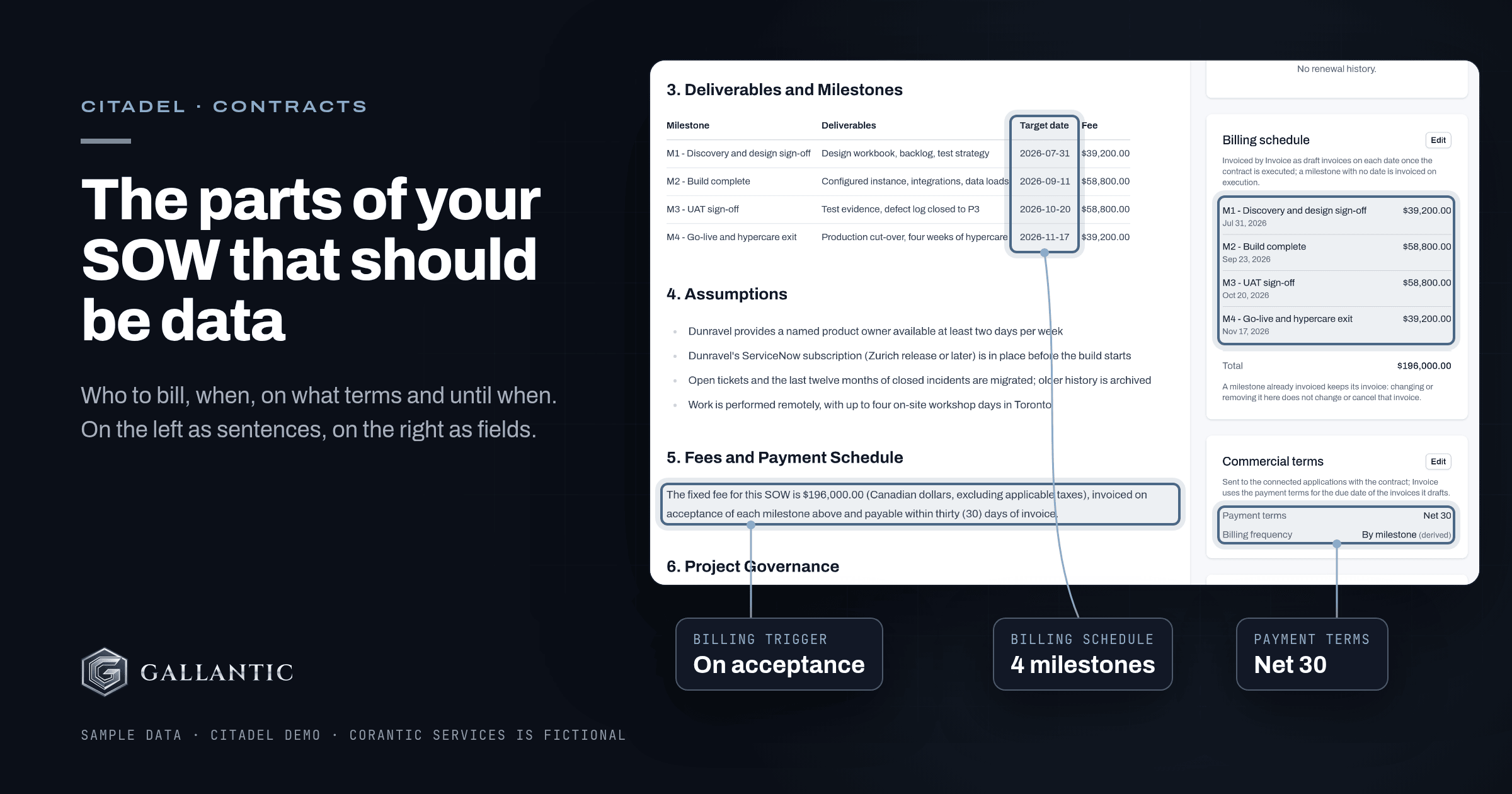
Corantic's ITSM implementation SOW for Dunravel Health has a milestone table like most fixed-fee SOWs:
| Milestone | Target date | Share of fee |
|---|---|---|
| M1 - Discovery and design sign-off | 2026-07-31 | 20% |
| M2 - Build complete | 2026-09-11 | 30% |
| M3 - UAT sign-off | 2026-10-20 | 30% |
| M4 - Go-live and hypercare exit | 2026-11-17 | 20% |
Two sections later, the fee clause says the fee is "invoiced on acceptance of each milestone above and payable within thirty (30) days of invoice". The acceptance clause gives Dunravel ten business days to review each deliverable.
So each milestone is invoiced on the day Dunravel accepts it, whatever the target date column says. For M2, that was twelve days after the target (we followed that invoice through billing in the handoff post). A finance team billing from the table would have invoiced M2 before acceptance, and Dunravel's payables team would have been within its rights to send the invoice back.
To bill this correctly, the record needs each milestone's amount, its target date and what triggers the invoice: a date, acceptance or completion. When the trigger is acceptance, someone needs to own recording the acceptance date, because that's the date the invoice goes out.
A bill-to party that changes mid-contract
Corantic is running a time-and-materials ITOM discovery and CMDB cleanup project for Strathlen Energy. Partway through, the work moved under Quarrendale Technology Partners, Strathlen's managed-services prime, and Corantic signed an amendment to match. From its effective date, Quarrendale engages Corantic as a subcontractor for the remaining work. Corantic invoices Quarrendale monthly in arrears, citing Quarrendale's purchase order, and invoices already issued to Strathlen remain payable by Strathlen. Scope, staffing and the hourly rate stay the same.
That one page changes three billing facts: who receives the invoice, the purchase order it has to cite, and which company owes which open invoices. It also took effect before it was written: the effective date is a week before the first draft and three weeks before the signatures, so the first monthly invoice under the new terms fell due before the paperwork was finished. If the only record is a signed PDF in a folder, that invoice goes to Strathlen out of habit, Strathlen's payables team rejects it, and the billing cycle restarts a month late.
At Corantic, the first invoice for hours after the effective date is drafted to Quarrendale with its purchase order number on it. The three Strathlen invoices that were overdue when the amendment was drafted are still overdue, so collections now involves two companies.
The fields that make this work are the bill-to party where it differs from the client, the purchase order and whether invoices must cite it, and the effective date of any change to either.
A renewal deadline that comes before the end date
Corantic's application managed services retainer with Oskerby Logistics runs for twelve months and covers 40 hours a month, invoiced monthly, with extra hours charged by the hour. It can be renewed for a further twelve months with sixty days' notice before the end date, and it doesn't renew automatically.
The date to watch is sixty days before the end date, when either side has to give notice. Corantic drafted the renewal SOW about three weeks after that date, at the same price, and sent it once it was approved. Oskerby's CIO, Marcus Bell, signed it less than a week before the old term ended. It worked out, but a decision the contract gave two months for was made in the last week of the term. Recording the notice date as well as the end date, with a reminder on it, leaves two months to settle the renewal.
The fields worth recording as data
Here's the list we'd put in front of any firm that writes SOWs, with examples from Corantic's documents.
| Field | Example | Who relies on it |
|---|---|---|
| Client legal entity | Dunravel Health Network | Finance, legal |
| Bill-to party, if different | Quarrendale Technology Partners Inc. | Finance |
| Purchase order, and whether invoices must cite it | Quarrendale's PO | Finance, the client's payables team |
| Commercial model | Fixed fee, time and materials, or retainer | Everyone |
| Rate | The hourly rate, for time and materials and for extra retainer hours | Finance, delivery |
| Contract value or ceiling | The not-to-exceed estimate on Kilvarra Credit Union's time-and-materials SOW | Finance, delivery |
| Billing schedule | Four milestones, each 20% or 30% of the fee | Finance, delivery |
| Billing trigger for each milestone | On acceptance | Finance, the delivery lead |
| Payment terms | 30 days | Finance |
| Retainer allowance and overage | 40 hours a month, extra hours billed by the hour | Delivery, finance, the account manager |
| Term, renewal and notice period | 12 months, renews with 60 days' notice | The account manager |
| Parent document | The MSA for a SOW, the SOW for a change order | Legal, finance |
| Client approvers | Who accepts milestones and approves releases | Delivery |
| Deferred and excluded items | An Epic integration left for phase two | Delivery, sales |
The hours budget behind a fixed fee belongs on the record but not in the client's copy. Dunravel's fixed fee was estimated at 1,120 hours. The client never needs that number, but your delivery lead does, because it's what they track to know whether the fee still covers the work. Those 1,120 hours are the subject of the first post in this series.
What to change in your SOW process
-
Put a commercial schedule in every SOW template, as a fixed table rather than paragraphs. It should hold the parties, bill-to, purchase order, model, fee, milestones with their triggers, payment terms, term and renewal. Keep the prose for scope and assumptions.
-
Have finance review the commercial schedule before the SOW goes to the client. Legal reads the terms and delivery reads the scope, but whoever bills from the schedule should check it too.
-
When an amendment or change order changes any of those fields, restate the field in full. The Strathlen amendment does this well. It names the new bill-to party, its billing email, the purchase order requirement, the effective date, and which open invoices stay with the original client.
-
After signature, give each field one owner. If finance keeps the billing schedule in the accounting system and delivery keeps its own copy in the PSA, agree now which one wins when they disagree.
How Citadel handles it
In Citadel Contracts, the billing schedule and commercial terms sit on the document next to its text: payment terms and billing frequency, plus the monthly value and hourly rate for retainers and time-and-materials work. Citadel Invoice drafts an invoice for each milestone when it falls due, sets the due date from the contract's payment terms, and holds it for someone to review. On a retainer it also holds the monthly hours allowance, and with Time and Support connected, hours are counted against it. Renewal and expiry reminders run on the dates the contract carries, at the lead times you set. Scope and assumptions stay as text in the same document, with the commercial fields alongside them.
This is the third post in a short series on running the back office of a services firm. The first two are A 12% Overrun Can Hide a 463% Miss and The Handoff Tax.