
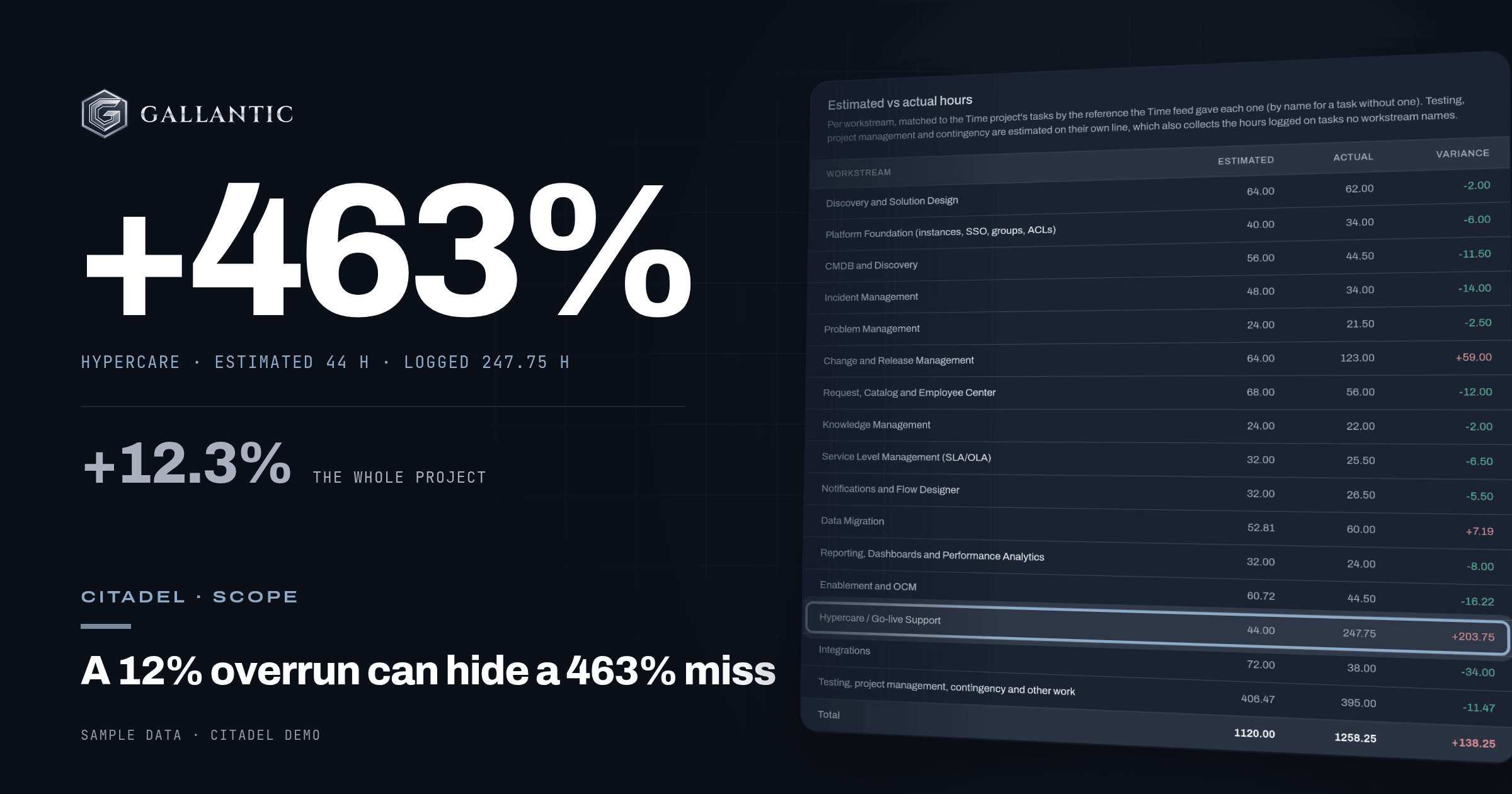
A ServiceNow partner sells a fixed-fee ITSM implementation to a regional health network: three hospitals, twelve community clinics and about 9,500 staff moving off a legacy ticketing tool. The estimate behind the fee says 140 days of effort, or 1,120 hours. Five months later, with hypercare nearly over, the timesheets show 1,258.25 hours.
That's 12.3% over, and the delivery lead has already written down why. A note on the project gives two reasons: the ticket-history migration was much larger than the legacy extract showed, and hypercare ran longer than planned to clear the post-release fixes. On a fixed fee the firm absorbs the difference, and with a cause on file it's easy to call it a hard project and move on. By workstream the estimate was off by far more than 12%, and the firm's next three estimates repeat its largest error.
An error like this repeats when nobody reads the estimate against the hours, line by line, and corrects the template that priced the job. That review is only easy to keep up when the estimate, the contract and the timesheets are connected from start to finish, which is how we built Citadel. The statement of work starts from the Scope estimate, the signed SOW opens the project in Time with the estimate's workstreams as its tasks, and Scope compares estimated and actual hours on every line. Corantic has had that comparison since the project opened, and hasn't yet used it to correct the template.
This example is based on issues we've seen on past projects. The firm, Corantic Services, and its client, Dunravel Health, are fictional.
The same project, line by line
Here is the estimate against the hours logged, workstream by workstream. Estimated hours are the estimate's days at eight hours a day.
| Workstream | Estimated (h) | Actual (h) | Variance |
|---|---|---|---|
| Discovery and solution design | 64.00 | 62.00 | -3% |
| Platform foundation (instances, SSO, groups, ACLs) | 40.00 | 34.00 | -15% |
| CMDB and Discovery | 56.00 | 44.50 | -21% |
| Incident Management | 48.00 | 34.00 | -29% |
| Problem Management | 24.00 | 21.50 | -10% |
| Change and Release Management | 64.00 | 123.00 | +92% |
| Request, Catalog and Employee Center | 68.00 | 56.00 | -18% |
| Knowledge Management | 24.00 | 22.00 | -8% |
| Service Level Management | 32.00 | 25.50 | -20% |
| Notifications and Flow Designer | 32.00 | 26.50 | -17% |
| Data migration | 52.81 | 60.00 | +14% |
| Reporting and dashboards | 32.00 | 24.00 | -25% |
| Enablement and OCM | 60.72 | 44.50 | -27% |
| Hypercare and go-live support | 44.00 | 247.75 | +463% |
| Integrations | 72.00 | 38.00 | -47% |
| Testing, project management, contingency and other | 406.47 | 395.00 | -3% |
| Total | 1,120.00 | 1,258.25 | +12.3% |
Three lines ran over, by 270 hours between them. The other thirteen came in under, by 132, and absorbed about half of the overrun. The 138.25 hours in the total is what was left.
Read that way, the estimate made large errors in both directions. Hypercare took more than five times the hours it was given and change management nearly twice, while integrations took about half.
The table also tests the delivery lead's note. Hypercare accounts for 204 of the 270 hours over budget, and the data migration line, which the note names first, came in 7 hours over. Read on its own, the note points at the smaller problem first, and it explains hypercare as fixes running long, when the estimate never covered the four weeks the SOW promised.
Why the offsets matter
An estimate is really a model of how your team delivers a kind of work, and you'll reuse it on the next deal. The project total only says how this one project went.
There's no reason to expect the same lines to come in under next time. At Dunravel, integrations took 38 hours against 72. The scope was single sign-on through Microsoft Entra ID and user and group provisioning from Workday, two integrations most ServiceNow teams have built many times, and a template that sizes every integration as though it were custom overprices the common ones. Another ITSM client may need a custom integration that uses its whole line, and have a more demanding go-live. That client gets you the full hypercare overrun with no integration cushion. On a competitive bid the mismatch hurts in a different way. The padded integrations line raises your price, while the thin hypercare line doesn't show up until after you've won.
Hypercare: the estimate and the contract disagreed
The estimate gave hypercare 5.5 days, or 44 hours. The statement of work, finished in May after four versions and two rounds of internal approval, says this in its governance section: "Hypercare runs for four (4) weeks after go-live, with daily stand-ups aligned to Dunravel's Thursday Change Advisory Board."
The tie to the CAB came from the client. In a comment on the draft, Dunravel's IT director, Olivia Grant, wrote: "Our Change Advisory Board meets Thursdays, so we have proposed aligning hypercare with it." Dunravel's redline went into the SOW the next day, and the estimate's hypercare line stayed at 5.5 days.
Four weeks is twenty business days, and forty-four hours over twenty days is a little over two hours a day for the whole team. That pays for the daily stand-up and its notes and leaves almost nothing for what a go-live across fifteen sites turns up.
Some of the 247.75 hours are the post-release fixes the note mentions, and the exit date later moved by a week because the runbook sign-off with Dunravel's service desk needed another pass. Even so, four weeks of hypercare across fifteen sites was always going to need several times 44 hours. The mistake happened before signature, when two approved documents disagreed about hypercare by a factor of four and neither review noticed. The estimate was reviewed as an estimate and the SOW as a contract, and the hours were never checked against what the contract promised.
Every implementation estimate Corantic has written prices hypercare at four to eight days, whatever the size of the go-live. Three drafts are open right now, for HAM, SAM and Security Operations implementations, and each gives hypercare five days. In the Security Operations draft, those same five days also have to cover enablement and go-live. The number comes from the offering templates, which have never been checked against a real go-live.
Change management: something discovery could have found
Change and Release Management came in at 123 hours against 64, and the SOW hints at the reason. One of Dunravel's stated objectives is a change success rate "reported monthly to the Board's audit committee", and hypercare was tied to a CAB that meets every Thursday. In a hospital network, change also touches clinical systems. Designing the workflows, the CAB calendar and the audit reporting around all of that is well beyond a standard Change build.
Unlike hypercare, this shortfall came from the client, and discovery could have found it. Raising the change line on every ITSM estimate would overprice the next client with a simple CAB. The better fix is a discovery question about change governance: is there audit reporting, a fixed CAB, or change on clinical or regulated systems? A yes should raise the change line.
How we'd review an estimate against its actuals
-
Review by workstream, not by the total. Set a threshold for discussion, such as 25% or two days on any line, whichever is larger. Then talk through every line that crosses it, including the ones that came in under.
-
Sort each miss into "this client" or "the template", the way hypercare and change management split at Dunravel. Fix template problems in the offering, and turn client problems into a question for discovery.
-
Read the estimate against the SOW before the client signs. Anything the contract promises in time or quantity, like weeks of hypercare, workshop days, migrated articles or catalog items, should match hours in the estimate. That includes what the client's redline adds. If the SOW says four weeks and the estimate says five and a half days, one of them has to change before signature.
-
Hold the review at hypercare exit, while the team still remembers why the change workflows took twice as long. By the annual pricing review six months later, those reasons are hard to reconstruct.
-
Check the time data before trusting the variance, because it only means something if people log time to the right tasks and keep logging after the budget runs out. Corantic's delivery lead asked the team to log every hour on the project until exit, "so the actuals stay true for the next estimate". In Corantic's report, testing, project management and contingency share one line, which also collects time logged on tasks that don't belong to any workstream, so a growing catch-all line means hours are landing in the wrong place.
Where Citadel fits
The table at the top of this post is a page in Citadel Scope, and it needed no export: the hours came from Time against the workstreams the estimate priced. The offering templates in Scope are where Corantic can now raise hypercare before its three open drafts go out.
You can do the same review with a spreadsheet, as long as your timesheet tasks match your estimate lines. If they don't, set up the next project's timesheet tasks from the estimate.