

If you manage a ServiceNow environment, you've probably checked your Subscription Management dashboards and felt reasonably confident about your licensing position. The numbers look fine, utilization seems healthy, and there are no glaring red flags.
But here's the question most organizations don't ask until audit season arrives: are those dashboards actually telling you the full story?
In our experience working with enterprises across North America, the answer is almost always no. Subscription Management dashboards show you what ServiceNow tracks by default. They don't show you how your users are actually consuming licenses, whether people are correctly categorized, or where you're quietly bleeding budget on licenses that could be reallocated for more strategic value.
That's exactly the problem we built NEXUS to solve.
The Gap Between "Licensed" and "Actually Using"
ServiceNow licensing is deceptively complex. You're not just counting heads. You're navigating fulfiller licenses, business stakeholder entitlements, approver roles, and a web of subscription types that each carry different per-user costs. The built-in dashboards give you totals and limits, but they can't tell you whether those allocations actually reflect how people work day to day.
Consider a common scenario: your ITSM fulfiller license count looks healthy at 88% utilization. But how many of those fulfillers are actually doing fulfiller-level work? How many logged in a handful of times over the past year and performed zero ticket resolutions? And on the flip side, how many unlicensed users are performing actions that ServiceNow's auditors would flag as requiring a license?
These aren't hypothetical questions. They're exactly the kind of findings NEXUS surfaces within minutes of connecting to your instance.
Starting With the Full Picture
NEXUS is a cloud-hosted intelligence platform with five specialized modules that each analyze a different dimension of your ServiceNow investment. For license optimization, three modules work together to give you a complete view: Health for license management and compliance, Productivity for user activity analysis, and Value for strategic cost assessment.
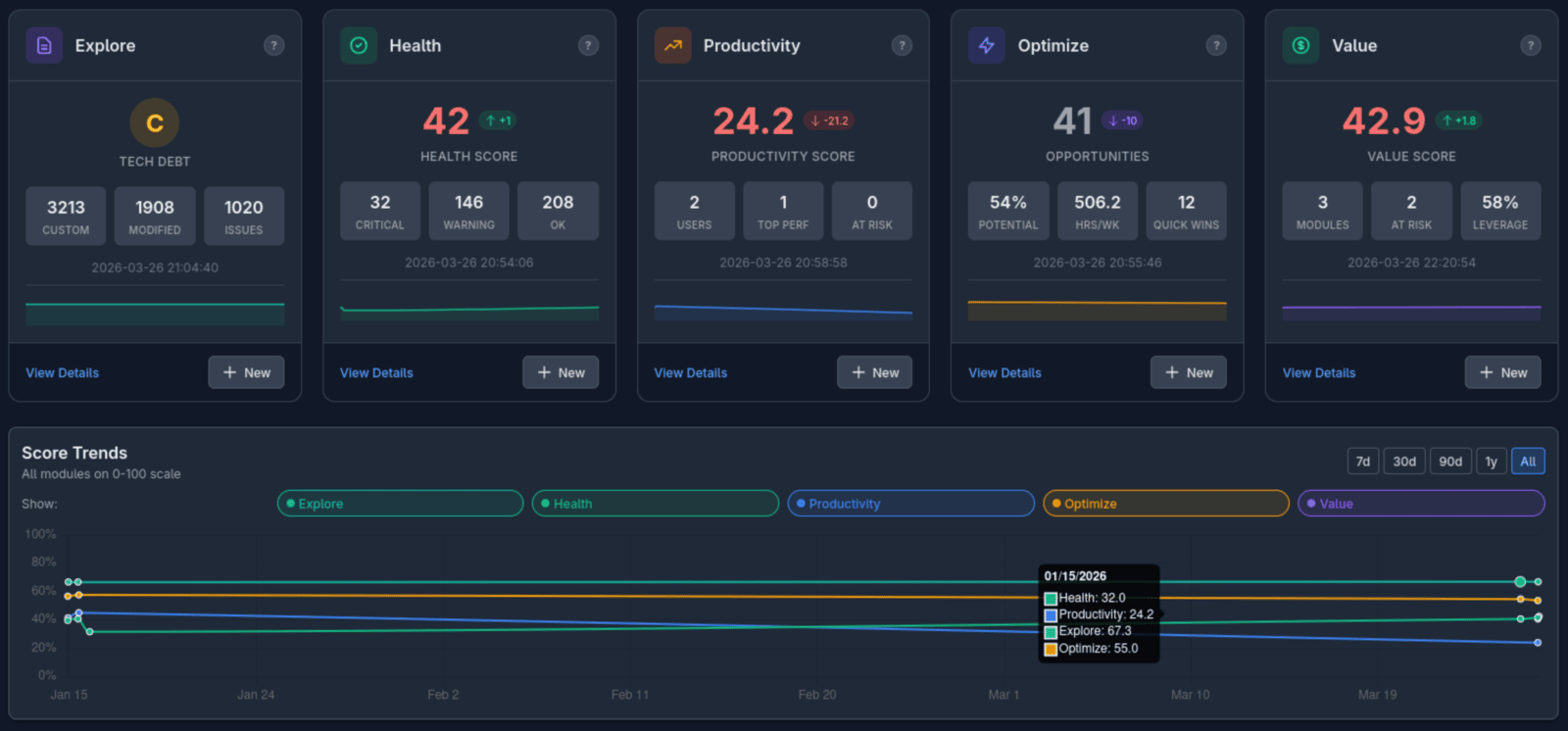
When you connect NEXUS to your instance, the first thing you see is your License Management dashboard inside the Health module. This isn't a rehash of what Subscription Management already shows you. NEXUS independently analyzes actual user activity, role assignments, and entitlement coverage the same way ServiceNow's own auditors would evaluate your instance during a compliance review.
Seeing Your Licensing the Way Auditors Do
Here's what a real License Management view looks like in NEXUS:
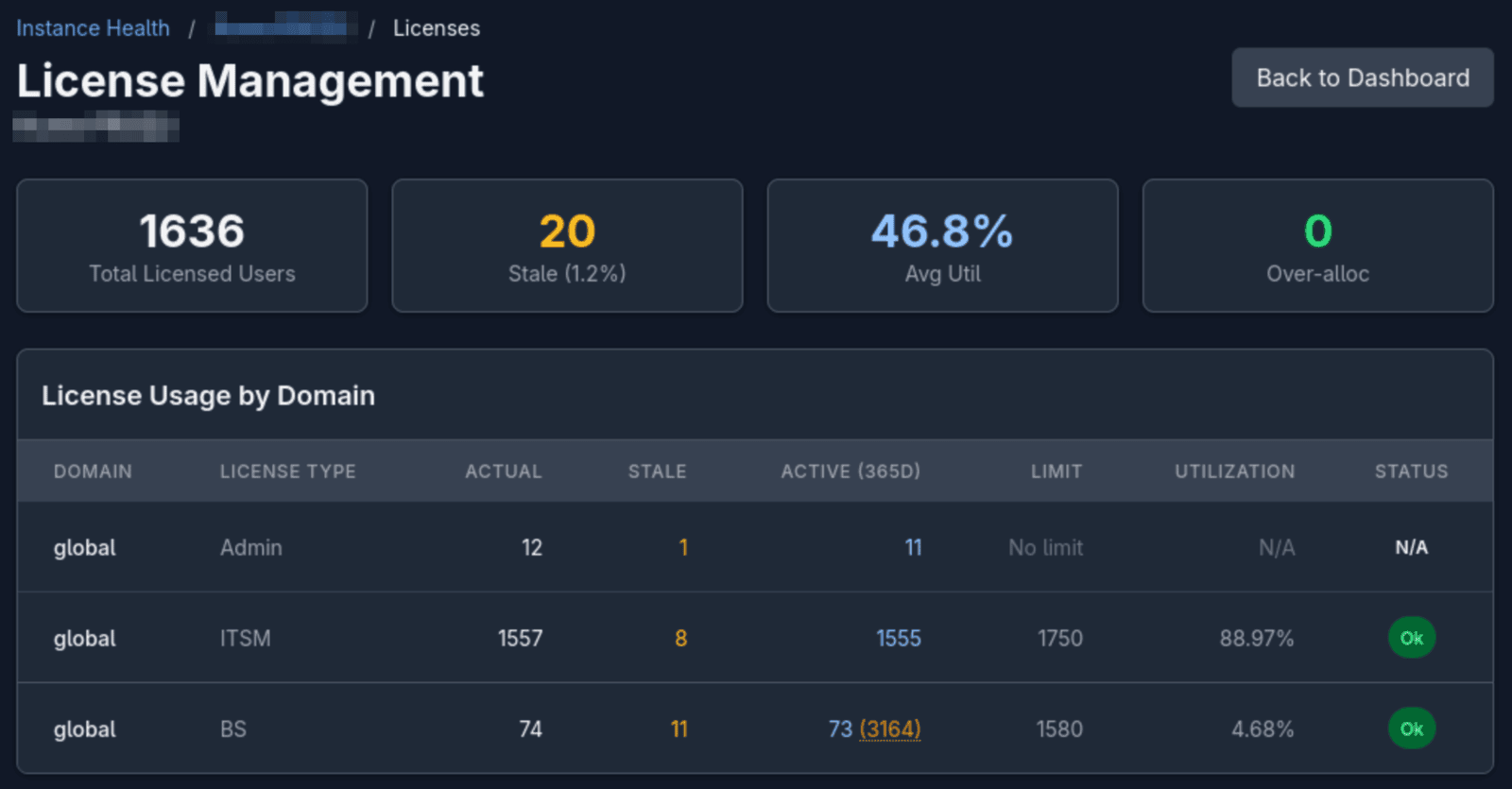
Right away, several things stand out. You can see your total licensed users, how many are stale (inactive accounts still consuming licenses), your true average utilization, and whether you have any over-allocation risk. But the real insight is in the domain-level breakdown.
In this example, the ITSM fulfiller pool shows 1,557 users with an 88.97% utilization rate. That looks healthy on the surface. But look at the Business Stakeholder row: 74 entitled users against a limit of 1,580. And that number in brackets? That's NEXUS telling you that 3,164 users are actually performing actions that require at minimum a Business Stakeholder entitlement but don't have one.
That's not a dashboard metric you'll find in Subscription Management. That's a compliance gap that could surface during your next ServiceNow audit.
The Unentitled Approver Problem
This is one of the most common and most expensive blind spots we see. NEXUS includes a dedicated Unentitled Approver Analysis that identifies every user who performed approval actions without holding the required license entitlement.
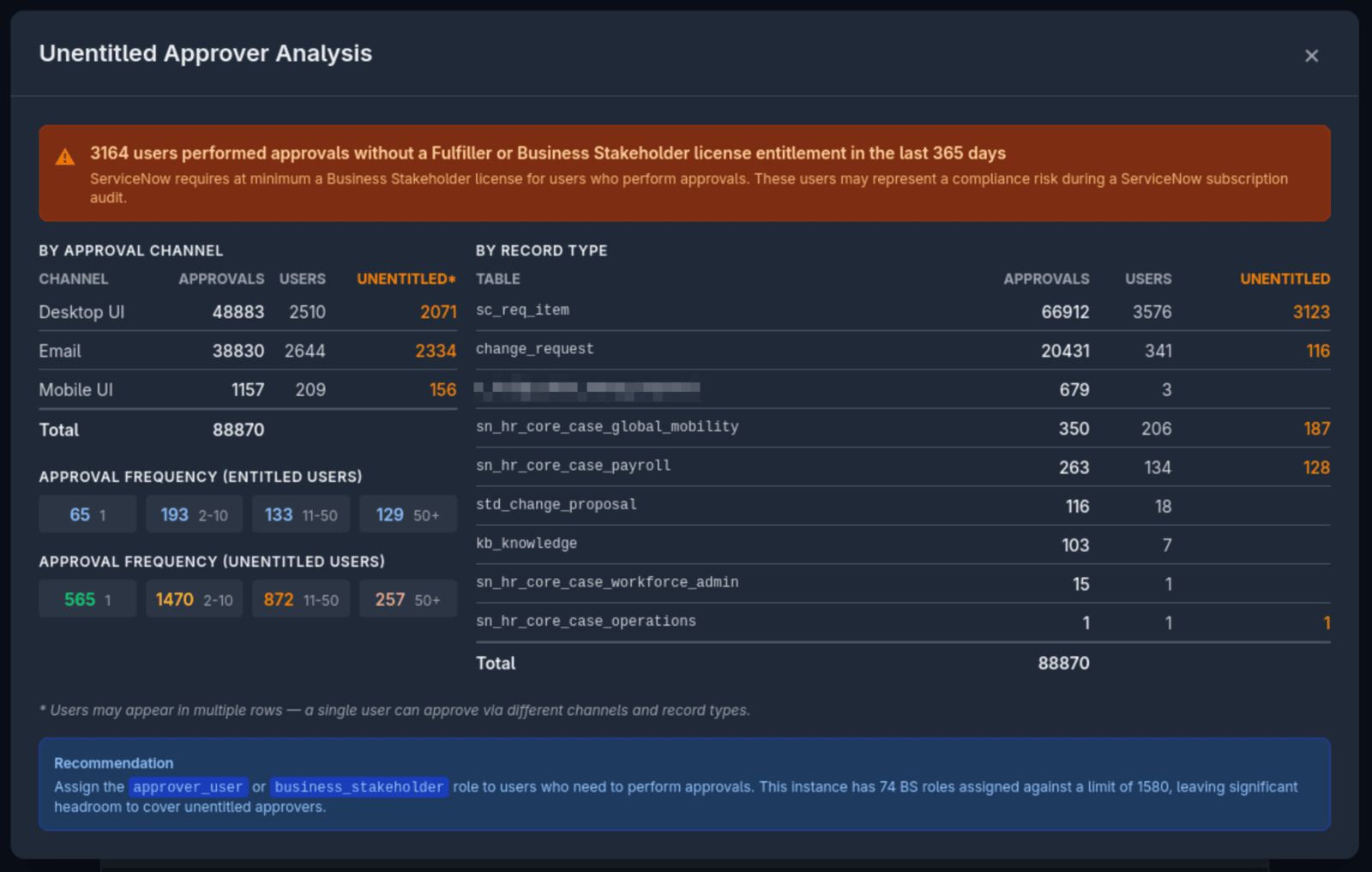
In this instance, 3,164 users performed nearly 89,000 approvals across Desktop UI, Email, and Mobile channels without a Fulfiller or Business Stakeholder license. ServiceNow's licensing terms require at minimum a Business Stakeholder license for users who perform approvals, regardless of whether they do any other work in the platform.
NEXUS breaks this down by approval channel and record type so you can see exactly where the exposure is. Service catalog request approvals account for the majority, followed by change requests. The analysis even checks how many Business Stakeholder roles are still available to be assigned, giving you a clear path to remediation before it becomes an audit finding.
The recommendation is straightforward: assign the approver_user or business_stakeholder role to users who need to perform approvals. In this case, the instance had only 74 of their 1,580 purchased Business Stakeholder licenses assigned. So while the organization had already paid for the headroom to cover a large portion of these unentitled approvers, they simply hadn't assigned the roles. That's a quick governance fix, not a budget conversation.
But here's where it gets more interesting. Do all 3,164 of those users actually need to be licensed as approvers? NEXUS digs deeper into approval frequency and finds that 569 of those users performed exactly one approval over the entire 365-day analysis period. These are incidental approvers, likely the result of one-time delegation, temporary group membership, or misconfigured approval rules. By implementing tighter approval workflow governance, such as removing inactive users from approval groups and tightening routing rules, this class of approver can be eliminated entirely. They don't represent ongoing approval needs and shouldn't require licensing.
Beyond that, another 1,475 users (nearly 47% of the total) performed only 2 to 10 approvals over the full year. This cohort represents significant optimization potential through approval process re-engineering: consolidating approval groups, automating low-risk approvals, or adjusting approval thresholds. A detailed review of these patterns as part of a broader workflow initiative could further reduce the number of users who genuinely require Business Stakeholder entitlements.
The takeaway: while ServiceNow's audit methodology might flag all 3,164 users as requiring a true-up, NEXUS gives you the data to defend a significantly lower number by demonstrating a concrete plan to restructure approval workflows and eliminate incidental approvers. That's a much stronger position to negotiate from.
Understanding Who Actually Needs a Fulfiller License
Here's where Productivity scoring becomes essential for license optimization. Not every user with a fulfiller license is actually doing fulfiller work. Some logged in a few times, maybe updated a record or two, and haven't touched the platform in months. Others are power users resolving hundreds of tickets with strong SLA compliance.
NEXUS's Productivity module scores every user across multiple dimensions: Volume, Quality, Consistency, Engagement, and Collaboration. This multi-dimensional view lets you see not just whether someone logged in, but whether they're actually performing work that justifies a fulfiller-tier license.
The difference is stark. Both of these users held ITSM fulfiller licenses during the same analysis period:
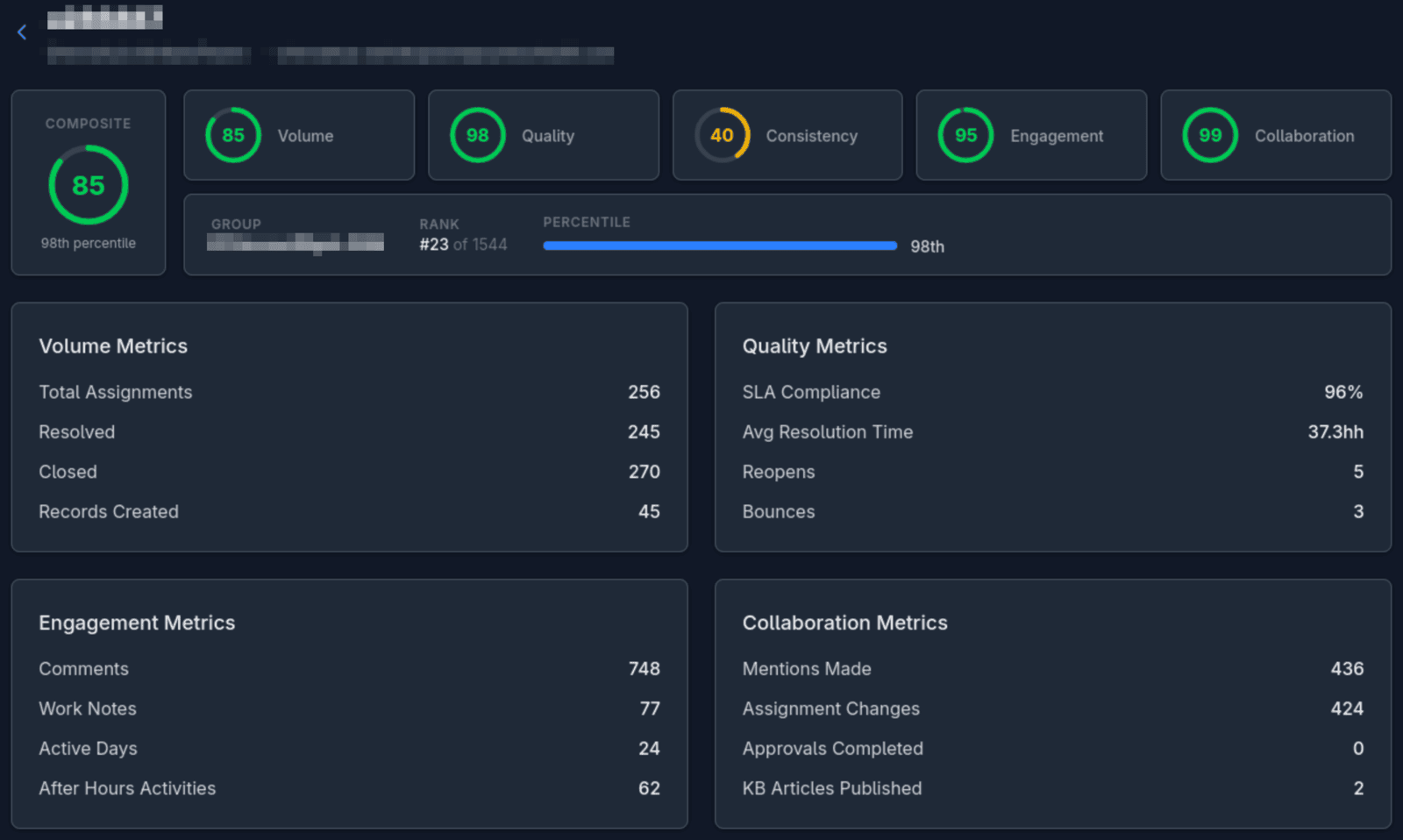
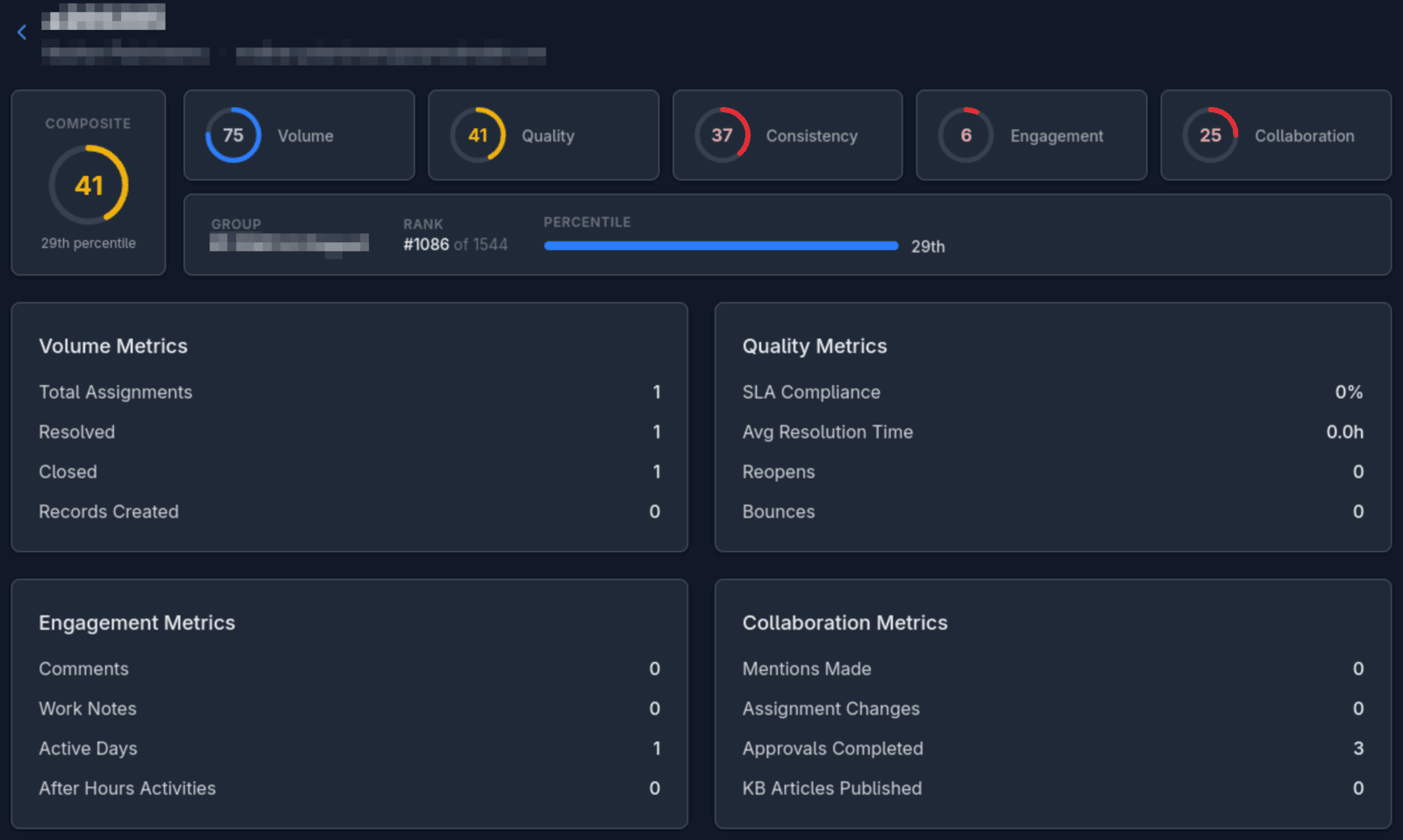
On the left, a genuine fulfiller: 256 assignments, 245 resolved, 96% SLA compliance, active across 24 days with significant after-hours engagement. This user ranked 23rd out of 1,544 fulfillers and is clearly delivering value that justifies their license tier.
On the right, a very different story. One assignment total, one active day, zero comments, zero work notes, and the only meaningful platform activity was three approvals. This user's actual behavior aligns far more closely with a Business Stakeholder license than a fulfiller license. They're paying the fulfiller premium for work they simply aren't doing.
When you multiply this pattern across an organization, the savings potential becomes significant.
Turning Insights Into Savings
This is where NEXUS connects the dots. The Value module analyzes fulfiller activity patterns against license entitlements and identifies users whose behavior suggests they may not need a fulfiller license at all.
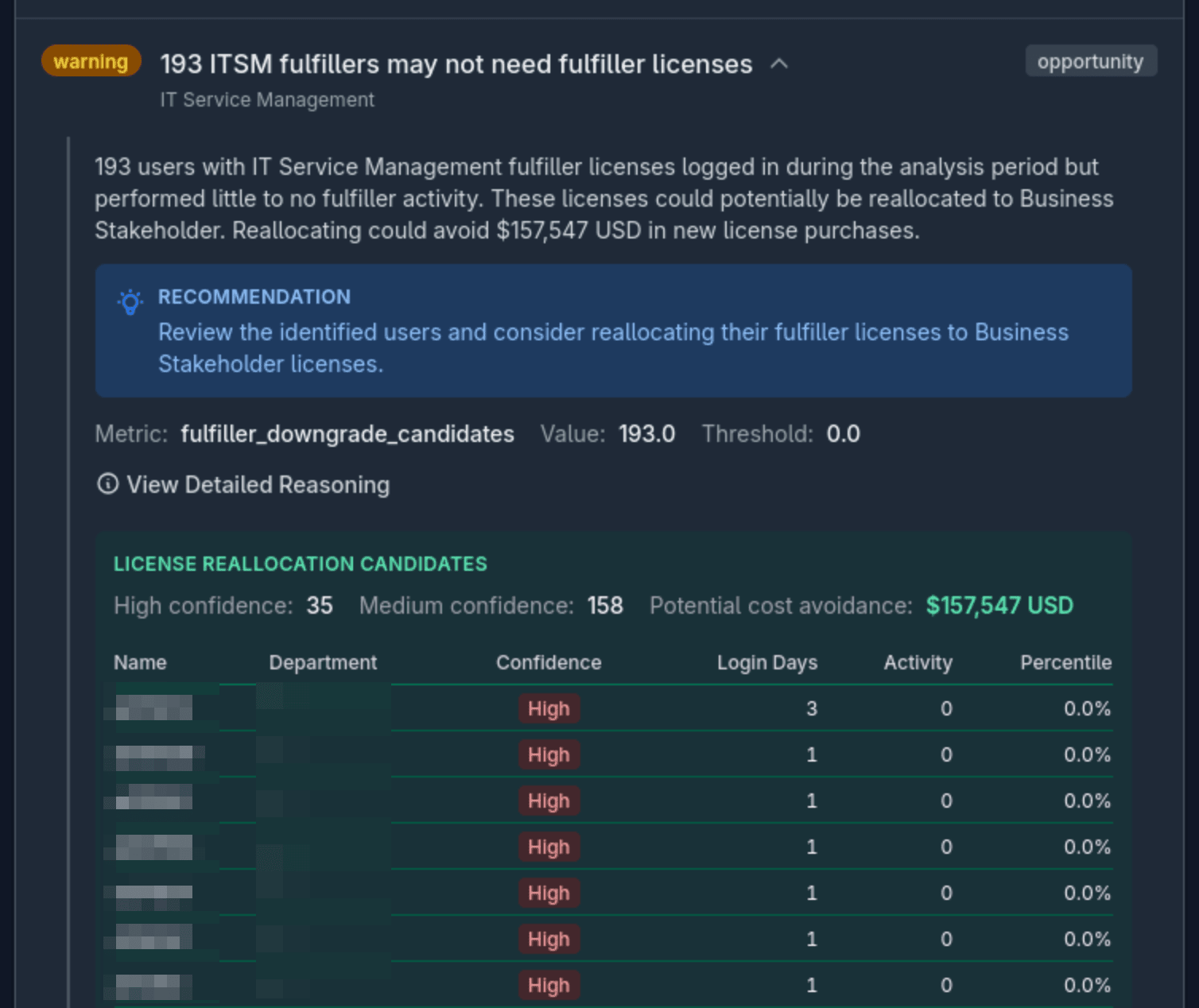
In this example, NEXUS identified 193 users with ITSM fulfiller licenses who logged in during the analysis period but performed little to no fulfiller activity. These aren't stale users who never logged in. They're active users who simply aren't using the platform in a way that requires the more expensive fulfiller license.
NEXUS scores each candidate by confidence level: 35 high-confidence candidates (users with near-zero fulfiller activity) and 158 medium-confidence candidates. Based on this customer's negotiated subscription pricing, the potential cost avoidance was estimated at $157,547 USD annually that could be redirected toward licenses or capabilities that actually drive more value for the organization. (Actual savings will vary by organization since ServiceNow pricing is negotiated and volume-discounted per contract.)
The reallocation path is simple: move these users from fulfiller licenses to Business Stakeholder licenses. They keep access to approvals and basic platform functions, but you stop paying the fulfiller premium for work they aren't doing.
Defending Your Position and Breaking the Spend Spiral
Every ServiceNow renewal comes with pressure to expand. Your account team or partner will point to usage numbers that suggest you need more licenses, more modules, more subscription units. Without your own data, it's difficult to push back. You end up in a spend spiral where each renewal grows larger without a clear understanding of whether that growth is justified by actual consumption.
NEXUS changes that dynamic. Instead of relying on ServiceNow's view of what you need, you walk into every renewal conversation, audit, or true-up discussion with an independent, data-backed picture of your actual usage. You can demonstrate exactly which licenses are actively consumed, which are underutilized, and where you've taken concrete steps to restructure workflows and eliminate waste. Call it governance, not cost-cutting.
The Value module takes this further by scoring each ServiceNow module you've licensed by adoption depth, calculating cost per active user, and classifying your strategic posture across your entire subscription. Modules you're heavily using get an "Invest" or "Defend" recommendation. Modules with low adoption and high cost get flagged for reduction or replacement. This gives you a clear framework for deciding where to grow your investment and where to pull back, based on what your organization actually needs rather than what you're being told to buy.
The budget recovered from right-sizing can be reinvested into areas that generate more organizational value: expanding self-service capabilities, enabling new departments on the platform, or investing in modules with higher strategic ROI. The goal isn't to spend less on ServiceNow. It's to spend smarter and make sure every dollar is driving outcomes.
Next Steps
If any of this resonates with your organization's ServiceNow experience, NEXUS can provide these insights within minutes of connecting to your instance. There's nothing to install, no agents to deploy, and no impact to your production environment.
The platform connects through ServiceNow's standard REST API, performs its analysis through secure, encrypted channels, and delivers a complete picture of your licensing position, user productivity, and optimization opportunities.
And license optimization is just one dimension of what NEXUS delivers. The platform also provides comprehensive instance health monitoring with 530+ automated checks, deep code analysis and documentation for understanding your customization footprint with technical debt analysis, automation opportunity detection that identifies where your teams are losing hours to manual work and reassignment loops, and ROI quantification with renewal negotiation intelligence to strengthen your position at the table.
If you’re preparing for an audit, approaching a renewal negotiation, or just want to understand whether your ServiceNow spend tracks actual usage, NEXUS gives you the data to make confident decisions.
Get in touch to see what NEXUS can uncover in your environment.